Strength Training for Beginners: Your First 12 Weeks
A plain-English starter plan: how many days, which movements, how to progress, and what to ignore when you are new to lifting.

Lift two or three days a week. Do full-body sessions. Learn six movement patterns before you worry about heavy weight. Add a little load or a rep when the last session felt manageable. Write everything down. That is a beginner program, and the rest of this post is the detail.
I'll lay out twelve weeks in three blocks of four. It's a general framework, not a prescription for your body. If you have a medical condition or an injury, check with your doctor or physical therapist first.
What "beginner" actually needs: patterns before load
A beginner's biggest gains come from getting better at the movements themselves. Your nervous system is learning to recruit muscle in a coordinated way, and that happens faster when the weight is light enough to focus on how you move.
So the first month isn't about how much you lift. It's about owning a squat, a hinge, a push, a pull, a carry and a brace. Heavy weight comes later, and it's safer and more effective when the pattern is already clean.
How many days per week
Two or three full-body sessions a week. Official guidance backs the low end: US adults are advised to do muscle-strengthening activity of moderate or greater intensity, covering all major muscle groups, on 2 or more days a week.1 The American College of Sports Medicine's position stand recommends 2-3 days a week for novice lifters.2 Its exercise-prescription stand says the same: resistance exercise for each major muscle group on 2-3 days a week, individualized to the person.3
Pick days with at least one rest day between them. Monday, Wednesday and Friday works. So does Tuesday and Saturday. Which days matters less than whether you actually show up.
- 2+days a week of muscle-strengthening (HHS guidelines)
- 2-3days a week for novice lifters (ACSM, 2009)
Source: US HHS Physical Activity Guidelines, 2nd ed.; ACSM position stand, 2009
The six movement patterns to learn
Every session should touch these in some form:
- Squat. Goblet squat to a box or bench is the usual start.
- Hinge. Romanian deadlift or kettlebell deadlift. Hips go back, spine stays long.
- Push. Push-up (hands elevated if needed) or dumbbell press.
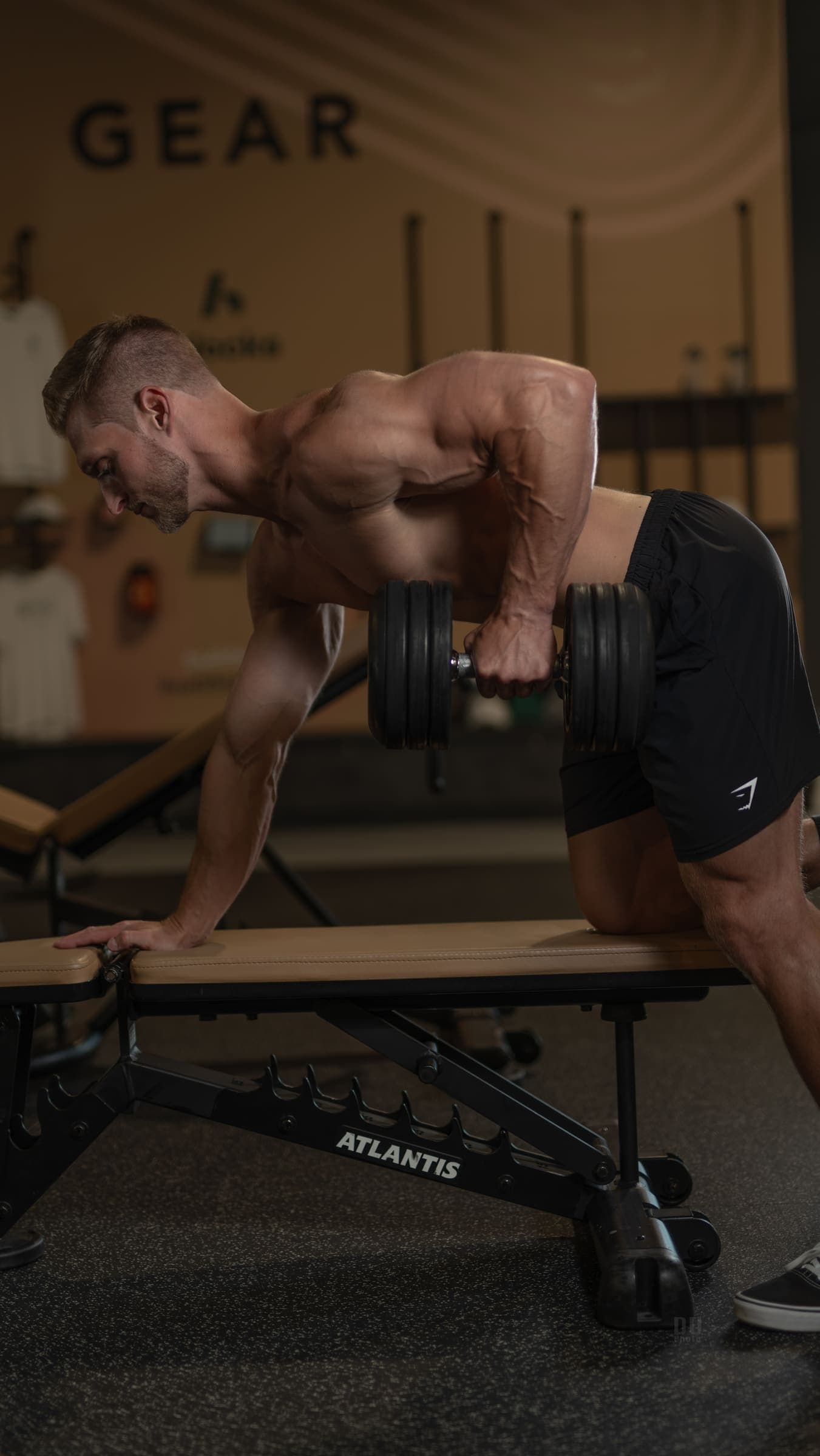
- Pull. One-arm dumbbell row or cable row.
- Carry. Farmer's walk with dumbbells in each hand.
- Brace. Plank or dead bug. This is learning to hold your trunk stable while your limbs move.
You don't need all six in every session, but across a week you should hit each at least twice. A simple session is one squat or hinge, one push, one pull and one carry or brace.
Weeks 1-4: learn and repeat
Do the same sessions each week. Two or three sets of 8-12 reps per exercise, with the last couple of reps feeling like work but not like a fight. The ACSM position stand suggests novice loads around an 8-12 repetition maximum, which in plain terms means a weight you could lift about 8 to 12 times before form breaks.2 Start lighter than that. Leave a couple of reps in the tank.
Rest 60 to 90 seconds between sets. Warm up first: five minutes of easy movement, then a lighter set of your first exercise. There's more on that in how to warm up before lifting.
The goal of the first four weeks is repetition. Same exercises, same order, slightly more comfortable each session. Boring is correct. One client, a frequent gym-goer whose progress had stalled, thought her plan looked "basic and too easy." Then, in her words, "The first week humbled my ego real fast." (C. N., Google review.)
Weeks 5-8: add load or reps, one variable at a time
Now you start progressing. Change one thing at a time. If you hit the top of your rep range on every set, 12 reps on all three sets for example, add weight next session. The ACSM stand suggests a 2-10% load increase once you can do one or two reps over your target.2 On a 20-pound dumbbell, that's a jump of half a pound to two pounds, so use the smallest plates you have.
If you're not ready for more weight, add a rep or a set instead. Don't add weight, reps and sets all at once. This idea is called progressive overload, and I cover it in progressive overload explained.
Weeks 9-12: reassess and rewrite
By now your first program has stopped being new. Your body has adapted, and the same workout produces less. Retest what you can: the weight you used for your first working set of each main lift, how many reps you get, how the movement feels. Compare against week 1.
Then change the program. Swap an exercise for a close variation (goblet squat to a front squat with light dumbbells, for instance), add a day if recovery is good, or add a set to the lifts you want to bring up. A good program gets rewritten about every four weeks, not never. That's how I run client programs: reviewed and rewritten monthly based on what the client's body actually did.
What to track and what to ignore
Track:
- Exercise, weight, reps and sets, every session.
- How hard the last set felt, on a scale of 1 to 10.
- Whether you did all your planned sessions.
Ignore:
- Soreness as a measure of a good workout. Being sore doesn't mean it worked, and not being sore doesn't mean it didn't.
- Daily scale weight as a judge of progress.
- Other people's programs, supplements and "secret" splits.
A log is the single most useful tool a beginner has. The client app I use with everyone lets you log each set on your phone and see your numbers over time. A notebook works too.
Why bother with all this? Lifting does more than change how you look. In a systematic review of cohort studies, people who did muscle-strengthening activity had lower risks of death and several major diseases, with the biggest benefit at roughly 30-60 minutes a week.4 That's an association in observational data, not proof of cause. But it's a reasonable argument for starting at all.
When a coach speeds this up
You can do everything above by yourself. A coach shortens the learning curve. Someone watches your squat and tells you what's off before it becomes a habit. Someone picks the next load so you don't have to guess. Someone rewrites your plan before you stall, not after.
Another client wrote that the structure kept her going: "Programs are so well organized, which makes it easy to stay on track and motivated." (Bethany G., Google review.) That's the point of a plan.
If you'd rather follow a structured plan on your own, look at a Sequential Program Series or 1:1 coaching. If you want someone watching your form, book a free consult and we'll talk about where you're starting from.
- Weeks 1-4
Learn the six patterns. Same sessions each week, 2-3 sets of 8-12 reps.
- Weeks 5-8
Add load or reps, one variable at a time.
- Weeks 9-12
Retest against week 1, then rewrite the program.
Footnotes
-
US Department of Health and Human Services, ODPHP. "Physical Activity Guidelines for Americans, 2nd edition." 2018. https://odphp.health.gov/our-work/nutrition-physical-activity/physical-activity-guidelines/current-guidelines ↩
-
American College of Sports Medicine (Ratamess NA, et al.). "Position Stand: Progression models in resistance training for healthy adults." Medicine & Science in Sports & Exercise 41(3):687-708, 2009. https://pubmed.ncbi.nlm.nih.gov/19204579/ ↩ ↩2 ↩3
-
American College of Sports Medicine (Garber CE, et al.). "Position Stand: Quantity and quality of exercise for developing and maintaining cardiorespiratory, musculoskeletal, and neuromotor fitness in apparently healthy adults." Medicine & Science in Sports & Exercise 43(7):1334-1359, 2011. https://pubmed.ncbi.nlm.nih.gov/21694556/ ↩
-
Momma H, et al. "Muscle-strengthening activities are associated with lower risk and mortality in major non-communicable diseases: a systematic review and meta-analysis of cohort studies." British Journal of Sports Medicine 56(13):755-763, 2022. https://doi.org/10.1136/bjsports-2021-105061 ↩